Etiam pulvinar consectetur dolor sed malesuada. Ut convallis
euismod dolor nec pretium. Nunc ut tristique massa.
Nam sodales mi vitae dolor ullamcorper et vulputate enim accumsan.
Morbi orci magna, tincidunt vitae molestie nec, molestie at mi. Nulla nulla lorem,
suscipit in posuere in, interdum non magna.
This is the second year of the Big Boss Zin and like last year, this Zin hails from the tiny AVA of California Shenandoah Valley, nestled in the Sierra Foothills.
This wine is a blend of 95% California Shenandoah Valley Zinfandel from Wilderotter Vineyard, and 5% Italian Primitivo from Mosti Mondiali.
This wine has the light body and characteristic fruity nose typical of the terrior in California Shenandoah Valley.
This wine practically made itself.
It was refrigerated for 24 hours before crushing “a pied” and was vigorously destemmed using milk crate technology.
After de-stemming the must was sulphited and cold soaked for 7 days.
It was pitched with Rhone yeast and oaked in a new small format Hungarian barrel from Vadai for 1 month.
Total production under 3 cases.
The Zinfandel was harvested 16-Sep-2008 with a Brix of 24.2, pH of 3.52 and a Ta of 5.9g/l.
The blending was done with the help of SaraGrace Keenan and Kim DiGirolomo.
The Bachus on the label is a modified version of artwork supplied by Appellation America and used with their permission.
This wine is a blend of 75% Madera AVA Sangiovese from Bruce Jackson’s vineyard, and 25% Italian Primitivo from Mosti Mondiali. A very small portion of small berry Syrah from Bruce’s vineyard was co-fermented with the Sangiovese.
The Madera AVA is characterized by heat, lots of it. Because of this, grapes ripen early, and acids can become unbalanced. Skin colour is also usually light compared to like grapes grown elsewhere.
This particular wine started out as a troublesome batch; the pH and Ta were not ideal; I had H2S problems, and the colour was poor. I probably learned more making this wine than any other previously. Liberal acid additions, doses of Copper Sulfite and Boskin, and gross filtering cured most of the ills; finally blending with the inky, over-oaked Primitivo from 2006 finished this wine into it’s current, pleasing, state.
It sat in a new, small format Hungarian barrel from Vadai for several weeks.
Total production under 4 cases.
The Sangiovese and Syrah were harvested 31-Aug-2008 with a Brix of 25, pH of 3.98 and a Ta of 8.3g/l.
Laurette Cisneros and Stacy Jones helped with the harvest.
The grapes were gently crushed by the feet of babes (Michelangelo and Isabella Alessio, with some help from their Mom and Dad)
The blending was done with the help of SaraGrace Keenan and Sean Petrie.
Bottling help was provided by SaraGrace and Kim DiGirolomo.
Special thanks to Bruce Jackson, who was more than generous in sharing his grapes with me.
The artwork on the label was done by my 4 year old daughter Isabella, who refers to this wine as “hers”. It is meant to represent a fairy drinking wine (she’s obsessed with Fairytopiaright now)
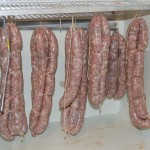
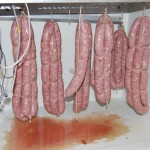
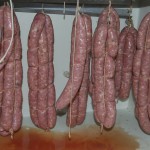
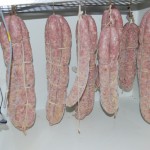
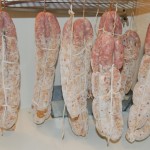
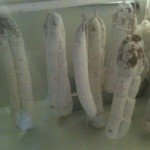
I’ve been wanting to make a fermented sausage product for years, and have never gotten off my but to do it before now. I mean, Salami just rocks, why wouldn’t I want to make some?
I call this guy Quattrofoil because that’s the heraldic term for a four lobed shape, and I tied four links together to make a larger chub.
four sheets
Ingredient
Quantity
Boston Butt
8.4Kg
Kosher Salt
77.4g
This was a rookie mistake. I was looking at the wrong column in my spreadsheet of adjusted numbers. There should have been twice the amount. Consider this a “Low Sodium” salami 🙂 The only concern is that the missing salt will adversely affect the curing process, most likely in a grayer colour than desired.
Corn Sugar
40.5g
Chili Pepper seeds (pepper flakes)
20.4g
Another instance where I was looking at the wrong column. This should be OK as we did fry some up and taste, and the heat level was appropriate for what we wanted anyways, and with a fermented sausage, I don’t think that the capsaicin was contributing significantly to anti-spoilage.
St. Patrick’s day is coming up, and we all know that in America that means corned beef. The tradition of corned beef on St. Pat’s day is strictly an Irish-American thing. In Ireland it’s unheard of.
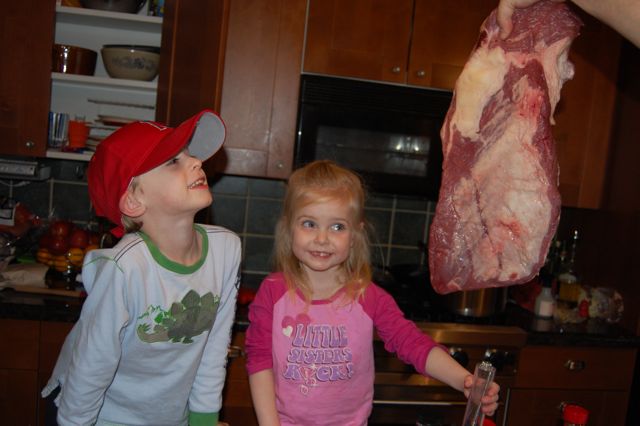
At the root of it; corned beef is simply a pickled beef brisket. I decided that this year I was going to do my own corned beef. So I pulled out Rytek Kutas’s “Great Sausage Recipes and Meat Curing", and looked up corned beef.
Once again, Rytek disappoints. His recipe is not easily adjusted for batch size; I prefer the way that Len Poli does his recipes – with metric weights so you can easily adjust them if you have more or less meat. This will shock some of you that know me and know that I never use a recipe when I cook; I simply adjust all to taste on my current whim (cooking is an art form after all); but in the case of preserving meat, the ratio of preservatives is damn important – too much you get poisoned; too little and you get sick because the meat rotted in the wrong way.
The other shortcoming that Rytek has is his ingredient list is weak.- it mentions something called “Pickling Spice” without defining it, and calls for dextrose. Dextrose, as any home brewer could tell you, is commonly available as corn sugar. It’s flavorless, and easily digestible by bacterials, yeasts, molds, and fungi. Flavorless describes Rytek’s recipes in general; and why in god’s creation would I want to provide spoilage biota with an easy meal?
Now, I’m pretty hard on old Rytek; but his book does provide a foundation to all this, so is a pretty valuable resource nonetheless. (I did eventually find out what “Pickling Spice” is – McCormick spices sells little 1.5oz bottles of it as "McCormick Pickling Spice". It’s cinnamon, allspice, mustard, coriander, bay leaves, ginger, cloves, chili, pepper, mace, cardamom, and sulfite.)
So, giving up on Krytek; I decided to check up on what Alton Brown of The Food Network show “Good Eats” would do to pickle his brisket.
I am a fan of Alton Brown. I love his scientific approach to cooking; he loves to explain why you do something when cooking. This makes us all better cooks. Alton’s recipe though had 2 major problems for me.
His recipe calls for saltpetre, and a 10 day cure.
Saltpeter, in addition to being a great food preservative and lawn fertilizer amongst other things, is a primary ingredient in gunpowder. In this post 9-11 world, the jackboot thugs at homeland security make it a pain in the ass to buy undiluted nitrates of any sort, so in order to preserve your meat, you need to instead buy sodium nitrite diluted by run of the mill salt and dyed pink (universally called prague powder #1). This necessitates figuring out how much prague #1 you need to equal the amount of saltpeter called for in the recipe; then figuring out how much salt is present in the prague powder, and adjusting the salt in the recipe to compensate; and living without the potassium that is normally in saltpetre. Yuck. I wish the fuckwads at homeland security would have better things to do than persecute me for wanting to make sausages!
Now, I can do math, and figure adjust Alton’s pre 9-11 recipe; but what I couldn’t do was maintain a 10 day cure as the prague#1 I ordered did not arrive until today, 8 days before the anniversary of the eviction of snakes from Eire.
Len Poli’s recipe calls for injecting the pickle into the meat and only curing for 5 days. Bingo! I could do this.
I bought my free-range organic brisket from Baron’s and since it was a whopping 8.3lbs I decided to pickle it now, do ½ for St. Pats, and make pastrami by cold smoking the other ½. Since I only had 8 days till St Pats, I decided to do a hybrid Len Poli-Alton Brown recipe. I couldn’t stick to Alton’s and simply inject the meat, as Alton calls for whole spices, which don’t fit in the marinade injector, so I made enough of Len’s pickle to inject, and did the rest as Alton’s to marinade, and threw in some of my own. Here’s what I ended up with:
Injection
6⅓ cups
Water
65g
Kosher salt
38.3g
Brown sugar
25.4g
Prague#1
5.2g
Pepper, finely ground
1.6g
Garlic powder
0.7g
New Mexico chili powder
Marinade
2Qts
Hot water
1 cup
Kosher salt
½cup
Brown sugar
2Tbs
Prague#1
1
Cinnamon stick, broken
5.5g
Yellow mustard seeds
3.3g
Black peppercorns
1.2g
Juniper berries (whole)
3
Bay leaves (crumbled)
1.7g
Ginger, chopped
stir, then add:
32oz
Water, really cold
1tsp
Coriander seed
1tsp
Capers
3 cloves
Garlic, chopped
1g
Red Pepper flakes
1
Star Anise
4
Cardamom seeds
1.1g
Bitter orange
Any leftover injection I added to the marinade, and placed the whole kit and caboodle in an old enamel roasting pan, covered with saran wrap (all air bubbles removed) and placed the whole shebang in the fridge until the eve before St Pats, when I plan on hacking it in half and putting the big half in a crock pot for the big dinner.
Update: 18-Mar-09
Sliced the flat off the briskit and returned it to the brine for later smoking (can you say Pastrami! YUM!). Doesn’t look like the brine fully penetrated the briskit. Next time remember to cut the fat off, and give it an extra week in the pickle.
Cooked up the point for St. Patricks day with cabbage, potatoes and carrots. It was unsliceable; the meat just fell apart. I think this is a good thing 🙂
Colour was good, but the flavour was missing something. Perhaps it did not pick up enough during the shortened brining process. Will add more spices next time, and as mentioned above; lengthen the brining time.
This sausage came from SGK’s desire to have a more kid friendly sausage. She took this to mean no red pepper; I took it to mean cheese.
5lbs
ground free range turkey. The ground turkey was cheaper than the whole. I chose turkey as it is lean and with the addition of the cheese I didn’t want it the sausage to be too fatty
5lbs
ground pork. I had this leftover in my freezer from the last time I made sausage.
2lbs
Precious brand low moisture mozzarella
1 entire bulb as big as my 5 year old’s fist
garlic
21
pearl onions. Red, white, and yellow
14.5g
Fennel seed. The fennel (or Anise seed in a pinch) is what makes an Italian sausage Italian.
10g
Caraway seed (supplements the fennel)
10g
Black pepper, coarse ground)
8.5g
Peppercorns, multi-coloured (for texture)
30g
Corn sugar. In a fermented sausage the sugar would serve as food for the bio that you add; in a fresh sausage like this one it’s to help bind the meat so it stays relatively firm.
6g
Coriander, ground
2.5g
Coriander seed, whole (for texture)
100g
Kosher salt. Kosher salt is not iodized. You don’t want to cook with iodine!
¼ cup
2004 Cline ancient vine zinfandel
2 cups
Water
4¼ oz
Trader Joes brand sun dried tomatoes in olive oil (The sun dried tomatoes were SGK’s idea)
8½ oz
Christopher Ranch brand Sun dried tomato pesto (The only kind of sun dried tomatoes they had at nob hill)
6g
Colmans yellow mustard powder
2g
Brown mustard seed
Several feet
32-35mm Hog casing
Grind the garlic, onions, tomatoes, and cheese with a coarse plate. Mix thoroughly and stuff.
I had a heck of a time with my little 5lb stuffer. I was using the medium sized spout, and I guess the cheese was clogging up the works. I switched to the large spout, which worked well, but it plumped the sausage thicker than I would have liked. I’m toying with the idea of getting a sausage stuffer attachment for my Kitchenaid mixer, which might help the problem as it has a continuous feed rather than a plunger like the 5lb stuffer.
The other problem I’m having is that the on a good number of the sausages, the links come undone, and when you cook them all the cheese comes out. I need to work on my linking technique.
butter not margarine sugar not splenda cheese not cheese-food bacon not facon hamburgers not garden burgers hot dogs not soy dogs coffee comes from beans, not flavour crystals and just say no to decaf! never mind the abomination of na beer


 right now)
 and looked up corned beef.
 It’s cinnamon, allspice, mustard, coriander, bay leaves, ginger, cloves, chili, pepper, mace, cardamom, and sulfite.)
 would do to pickle his brisket.
 so I made enough of Len’s pickle to inject, and did the rest as Alton’s to marinade, and threw in some of my own. Here’s what I ended up with:
  . I was using the medium sized spout, and I guess the cheese was clogging up the works. I switched to the large spout, which worked well, but it plumped the sausage thicker than I would have liked. I’m toying with the idea of getting a
  for my Kitchenaid mixer, which might help the problem as it has a continuous feed rather than a plunger like the 5lb stuffer.