A sample text widget
Etiam pulvinar consectetur dolor sed malesuada. Ut convallis
euismod dolor nec pretium. Nunc ut tristique massa.
Nam sodales mi vitae dolor ullamcorper et vulputate enim accumsan.
Morbi orci magna, tincidunt vitae molestie nec, molestie at mi. Nulla nulla lorem,
suscipit in posuere in, interdum non magna.
|
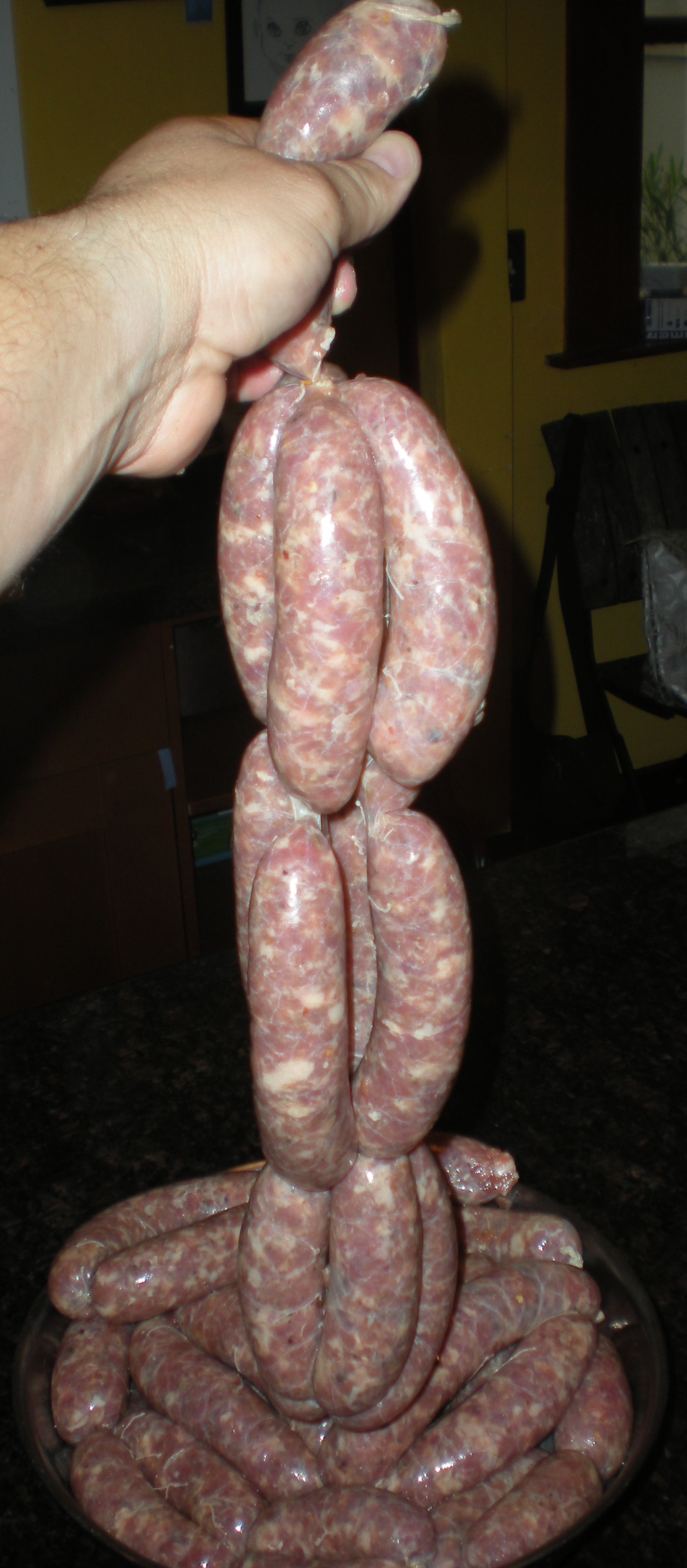 It’s been a while since my friend Scott (different friend from the Kimchee Scott) and I last made sausage from the Mule Deer that I brought back from Colorado, so I figured it was time again. It’s been a while since my friend Scott (different friend from the Kimchee Scott) and I last made sausage from the Mule Deer that I brought back from Colorado, so I figured it was time again.
The Venison sausage came out on the dry side (despite liberal additions of Pork Fat) so this time I decided to follow a known recipe more closely. I chose one of Rytek Kutas’s from his book “Great Sausage Recipes and Meat Curing"
Now, I’m not really a fan of Rytek’s; mainly because he recommends to not-culture fermented sausages and IMHO that is a recipe for disease. I simply chose his recipes to check the ratios in my ingredients.
I started with about 20% more meat than his recipe calls for, so I bumped up his ingredients by about 20%. Since he uses household measure, this was hard to figure out until I decided to use the Blade scale that I bought for wine making to weigh most of his measures and then increase by ±20%. I would then fry some up and taste it so I could make any adjustments before stuffing. What I found was that following Rytek’s recipe produced an incredibly boring sausage; so I pulled an Emiril and bumped it up a notch. Here’s what I ended up with: that I bought for wine making to weigh most of his measures and then increase by ±20%. I would then fry some up and taste it so I could make any adjustments before stuffing. What I found was that following Rytek’s recipe produced an incredibly boring sausage; so I pulled an Emiril and bumped it up a notch. Here’s what I ended up with:
| 12.37lbs |
pork shoulder but roast bone in. |
| 1 entire bulb as big as my 5 year old’s fist |
garlic |
| 17g |
Fennel seed. The fennel (or Anise seed in a pinch) is what makes an Italian sausage Italian. |
| 20g |
Caraway seed (supplements the fennel) |
| 8.1g |
Black pepper, coarse ground) |
| 1 Tbl |
Peppercorns, multi-coloured (for texture) |
| 25g |
Red pepper flakes, crushed |
| 2 Tbl |
Corn sugar. In a fermented sausage the sugar would serve as food for the bio that you add; in a fresh sausage like this one it’s to help bind the meat so it stays relatively firm. |
| 6.3g |
Coriander, ground |
| 2.3g |
Coriander seed, whole (for texture) |
5 “throws”
(a throw is the precision measurement where the wife pours some in her hand then dumps it in) |
Kosher salt. Kosher salt is not iodized. You don’t want to cook with iodine! |
| 30gWhite onion |
| 106g |
Red onion |
| Splash |
2004 Esprit de Beaucastel |
| 2.5 cups |
Water |
| Several feet |
32-35mm Hog casing |
I used the Meat grinder attachment on my wife’s KitchenAid Mixer on my wife’s KitchenAid Mixer to grind the meat, onions and garlic. I used the large grinding plate as I wanted texture to my sausage. to grind the meat, onions and garlic. I used the large grinding plate as I wanted texture to my sausage.
I used a mortar and pestle to lightly crack the whole seed spices (peppercorns, coriander, carraway, and fennel). I prefer using a molcajete to a traditional ceramic mortar to a traditional ceramic mortar as the volcanic stone in the molcajete gives a texture to grind against. as the volcanic stone in the molcajete gives a texture to grind against.
Mix all ingredients thoroughly, then take a tablespoon full of what you got and fry it up to taste if it’s going to be OK. If not, then adjust the spices to taste
Stuff and link.
Enjoy!
MRA
Update 15-Feb-09 Fried some up for breakfast. Next time I’ll go lighter on the corriander.
Update 16-Feb-09 It needs more heat. More pepper flakes or perhaps chili powder next go
Kim Chi
My friend Scott and I have been toying with the idea of making Kimchi for a while now; and in a drunken Thanksgiving moment, we decided to give it a try.
On the surface, Kimchi should be an easy slow food to make; it’s nothing but spicy cabbage based fermented vegetable dish.
The hard part is the culturing.
Whilst it is possible to make Kimchee without a culture; if I rot my food on purpose, I want to stack the deck that it will rot in the proper manner.
It turns out that Lactobacillus Kimchi KoreEnsis is not available commercially in North America (at least that I could find – Please if anyone knows where to find it let me know!), so that left us with a couple of choices:
- Sympathetic Magic:
Feed the new batch of Kimchi with a sample of a previous successful batch.
The thought here being that there will be enough live flora in the other batch to successfully inoculate this one.
- Substitution:
Lactobacillus Kimchi KoreEnsis is a homofermentative lactic acid bacteria. I could simply add some Lactobacillus Acidophilus instead and hope that it could survive the high-saline environment.
We decided on the “Sympathetic Magic” route, and Scott picked up some Kimchee at a Korean grocer in Oakland; but alas; he forgot to bring it home!
So we ended up using some of my dietary supplement Acidophilus pills instead.
We also hoped that despite the preservative added to it; that the Kimchi sauce we bought would have some live bioflora in it.
We started by loosely following the directions from The Pyongyang Metro.
Ingredients:
- Chinese Cabbage
The “Chinese Cabbage” at my local Nob Hill was really adult Bok Choy.
There was an “Oriental Cabbage” that looked more similar to the ones that the girls on the metro were using; but more yellow and with less central stalk; likely not the same variety at all, but I picked up 2 heads and Scott picked up 2 additional heads.
I also picked up 2 heads of Bok Choy and Scott picked up some young Bok Choy, and I threw in a head of Radiccio for colour.
- Spring Onions
Not sure what these really are, so I chose green onions instead.
- Sea Salt
Scott picked up some “Korean Sea Salt” at the afore mentioned green grocer; but we decided to use my already opened Kosher salt as the real objective here is a non-iodized salt.
- Korean Chili Powder
I substituted Mexican Chili Powder and we cut up a handful of red jalapeños as well
- Crushed Garlic
Ours was finely chopped
- KimChi Sauce
Ours was a different brand; and included amongst it’s ingredients: “Squid Juice” and other fish-based weirdness.
- Crushed Ginger
Ours was grated
- Onion
I picked out a red one.
- Additional Ingredients
we also threw in a quartered and thinly slices daikon radish, and since the whole idea sprang from Scott’s recollection of a turnip kimchi, we sliced and quartered some of these as well.
We did not bother to measure the ingredients carefully, and likely added too much chili powder.
If it’s too spicy post-ferment, we’ll make some more with only cabbage to mix in and dilute the spice.
We didn’t let the cabbage brine for the full 6 hours that the Metro girls recommend, as we began making it at 17:30.
Scott did most of the mixing as I sliced the end of my finger off on the
Mandoline Slicer
early on in the evening, and we didn’t want to get much human blood in the mix.
I left it in the kitchen overnight to allow a warm environment for the culture to incubate in, then brought it down into the wine cellar where it will remain, fermenting away for a few more days.
It already tastes great!
Updates
- 03-Dec-08:Moved Kimchi to garage
- 05-Dec-08:Moved Kimchi to refrigerator
My neighbor Niaz Yosofzay is a great guy. He has a farm up in the sierra foothills and always shares it’s bounty with us. When he learned that I was a zymurgist, he volunteered some of his grapes. Given the location of his farm up near the Fair Play AVA, my mouth started to water with visions of old vine Mataro, Zin, or Petite Sirah. Alas, Niaz was volunteering a grape grown over his arbor in his backyard in Alameda.
Despite Niaz’s assurances that this was a wine grape that he brought back from Afghanistan (he’s a Pashtun), I suspect it is Concord (big leaves, slip skins, and the dead giveaway: it smells like Welches)
Not to look a gift horse in the mouth; Niaz and I picked the vine bare and Michelangelo and I cleaned our feet and stomped them flat.
As the wine progressed, I became quite proud of it. It is likely technically the best wine I have made to date. It had great clarity, good balance, a real fruity aroma, and very true to the characteristics of the varietal. Unfortunately, the varietal is Concord. Due to low alcohol, and high PH (and as Concord wine is not really what I was after), I decided at the end to krausen it as I would a beer (the positive pressure in the bottle will help forestall spoilage) and serve it cold. In other words, rather than making a “vineyard designate (Niaz’s Arbor) San Francisco Bay AVA sparkling Labrusca”; I’ll make a cider out of it.
04-Sep-07 – Niaz and I picked the grapes; Michelangelo and I stomped them. We ended up with ±5 US Gallons of must. 17 brix @ 68℉ = 1.067 specific gravity, TA = .6% pH = 4.9. It tastes like Welches Grape Juice. I am worried about the starting gravity. I want to bring it up by another 35G/L (to a specific gravity up to 1.1). My calculations give 412.5g needed so I chaptalized it with 15oz of corn sugar to bring it up. I pitched it with the Lalvin 71B that I had left over from the Mosto Italiano kit. The resulting must soon took on the aroma of bread.
05-Sep-07 – Not much fermentation going on. Smells awesome. Punched down.
06-Sep-07 – Lots of thick cap. on a twice daily punched down routine.
09-Sep-07 – Pressed. Yielded about 2.5 US gallons. Very light in colour.
18-Sep-07 – Racked. Hydrometer reads .996 @68℉ = .997 reads .996 @68℉ = .997
30-Sep-07 – Racked and finned with 42ml of 10% egg whites. Does not really taste too bad at this point; still predominately Welches.
17-Oct-07 – Smells like jelly. Fantastic colour. Still tastes like Welches.
04-Nov-07 – Started cold stabilization. Normally with the low acid I would not do this; but since I’m planning on serving it chilled I don’t want any tartaric crystals dropping out in someone’s glass. Put oak in the ½ gallon bottle as a test
13-Jan-08 – Fridge in mid 30’s (℉) Clarity is unparalleled. still smells of jelly and tastes of Welches. Colour is awesome. The unoaked sample was very simple in flavour; the oaked is slightly better so I added about ⅓ of the American oak left over from the Mosto Italiano kit
19-Jan-08 – Doug Jefferys came over for a barrel tasting. He said: "Big fruity nose. Yep, Concord when tasting 🙂 Carbonate and drink!"
Sometime between Jan and Apr – Moved to cellar as I’m worried it is warming up in the garage
13-Apr-08 – looks like malolactic has occurred as the corks have pushed out and sprayed residue all over cellar
20-Apr-08 – The small bottle is way,way cloudy
17-Sep-08 – added 7oz of corn sugar and crown capped in 187ml bottles. I had intended on using plastic champagne corks; but the bottles I got do not accept the corks I have. I chose the small bottle as this is not the kind of wine you would want more than a ¼ glass of in a sitting. Cellared all bottles.
27-Feb-09 – Chilled a bottle and tasted. SGK liked it. She thought it was a cider not a sparkling wine. (reaction I was hoping for). Not as much carbonation as I want. I’ll move it to the Garage in spring so the warmer temperature should activate the yeast to continue carbonation.
|
|